
Painful urination, urgency, frequent trips to the toilet, or blood in the urine are easy to attribute to infection, but a repeating menstrual pattern changes the questions you should ask. By the end, you will know which bladder symptoms deserve review, which warning signs require urgent care, and what information and tests can help distinguish endometriosis from other urinary conditions.
Key takeaways
- Track urinary pain, urgency, frequency, and symptoms linked to your menstrual cycle.
- Recurring symptoms with negative urine tests need assessment beyond repeated UTI treatment.
- Seek urgent care for inability to urinate, blood in urine, fever, or severe flank pain.
- Ask about ureter checks because silent blockage can damage kidney function.
Which bladder symptoms can point to endometriosis?
Bladder involvement can feel like painful urination, urinary urgency, frequent urination, or bladder pressure above the pubic bone. Pain may spread into the pelvis, worsen as the bladder fills, or leave you feeling that you have not emptied fully after urinating.
Some people notice blood in the urine, either pink, red, or brown urine that you can see, or microscopic blood found on testing.
Track these details for each episode:
- The date and time symptoms begin, including whether they start before or during menstruation.
- How often you urinate, whether urgency causes leakage, and whether pressure improves after emptying your bladder.
- Burning or pain during urination, difficulty starting the stream, weak flow, or a feeling of incomplete emptying.
- Visible blood, separate vaginal bleeding, fever, flank pain, and urine-test or culture results.
| Pattern | What it can indicate | What to record |
|---|---|---|
| Symptoms recurring before or during menstruation | A cycle-linked pelvic process, including possible bladder endometriosis | Cycle day, bleeding, pain, urgency, and frequency |
| Symptoms throughout the month | Bladder endometriosis or another bladder, pelvic-floor, or urinary condition | Daily severity and triggers |
| Blood noticed during menstruation | Urinary blood can be mistaken for vaginal bleeding | Collect a clean urine sample when advised |
| UTI-like symptoms with negative cultures or return after antibiotics | Infection is not confirmed; further assessment may be needed | Culture result, antibiotic dates, and symptom response |
These symptoms overlap with cystitis, overactive bladder, bladder pain syndrome, stones, and pelvic-floor dysfunction, so symptoms alone cannot establish the cause.
How can you tell bladder endometriosis from a UTI or bladder disorder?
A repeating menstrual pattern is the clearest clue: symptoms that start or intensify before or during bleeding, then recur monthly, deserve assessment for bladder endometriosis. Urinary symptoms alone cannot confirm it, because several conditions overlap.
| Condition | Features that fit it better | What weakens that explanation |
|---|---|---|
| Urinary tract infection | Sudden burning, urgency, frequency, cloudy or strong-smelling urine, and a positive urine test or culture | Repeated symptoms with a negative urine culture, or recurrence at the same menstrual phase |
| Overactive bladder | Urgency and frequent urination without pelvic pain, blood, or a cycle-linked pattern | Painful urination, visible or microscopic blood, or symptoms that worsen around menstruation |
| Interstitial cystitis | Long-lasting bladder pressure or pain that increases as the bladder fills and eases after urination; cultures remain negative | A predictable menstrual pattern or a clear infection |
| Kidney stones | Severe, wave-like flank or back pain, nausea, and blood in the urine | Isolated monthly bladder pain without colicky flank pain |
| Pelvic-floor dysfunction | Difficulty starting urine, incomplete emptying, pain with sitting or sex, and tender or tight pelvic muscles | Cycle-linked urinary pain or blood without another explanation |
A negative urine culture does not prove endometriosis, and infection can coexist with it. Ask for urine testing during symptoms and assessment for obstruction; targeted transvaginal ultrasound or MRI may identify deep disease when a routine scan misses it.
When do urinary symptoms need prompt or emergency care?
Cyclic symptoms that begin before or during menstruation deserve a routine review, especially when they recur monthly, persist between periods, or continue after negative urine cultures or antibiotics.
Blood in the urine that appears predictably with menstruation is a useful clue, but do not dismiss symptoms if you never see blood: microscopic hematuria and bladder symptoms can occur without visible hematuria. Menstrual bleeding can also be mistaken for urinary bleeding, so mention exactly when you noticed it.
| Urgency | Pattern or warning sign | What to do |
|---|---|---|
| Routine review | Stable urgency, frequency, painful urination, pelvic pressure, or cyclic symptoms without fever or severe pain | Arrange a planned assessment and record the timing, urine results, and menstrual dates |
| Prompt assessment | New visible hematuria, repeated microscopic hematuria, symptoms that persist after treatment, recurrent “UTIs,” or flank or back pain | Seek medical assessment within days for urine testing, kidney drainage assessment, and targeted imaging |
| Emergency care | Inability to pass urine, severe or rapidly worsening flank pain, fever with chills, vomiting, confusion, faintness, or heavy blood or clots blocking urine flow | Go to an emergency department immediately |
Do not wait for routine review if imaging has shown hydronephrosis or possible ureteral narrowing. Obstruction can damage kidney function while urinary symptoms remain mild, and pain treatment or hormonal treatment alone does not restore blocked drainage.
Why can ureteral endometriosis be more serious than its symptoms suggest?
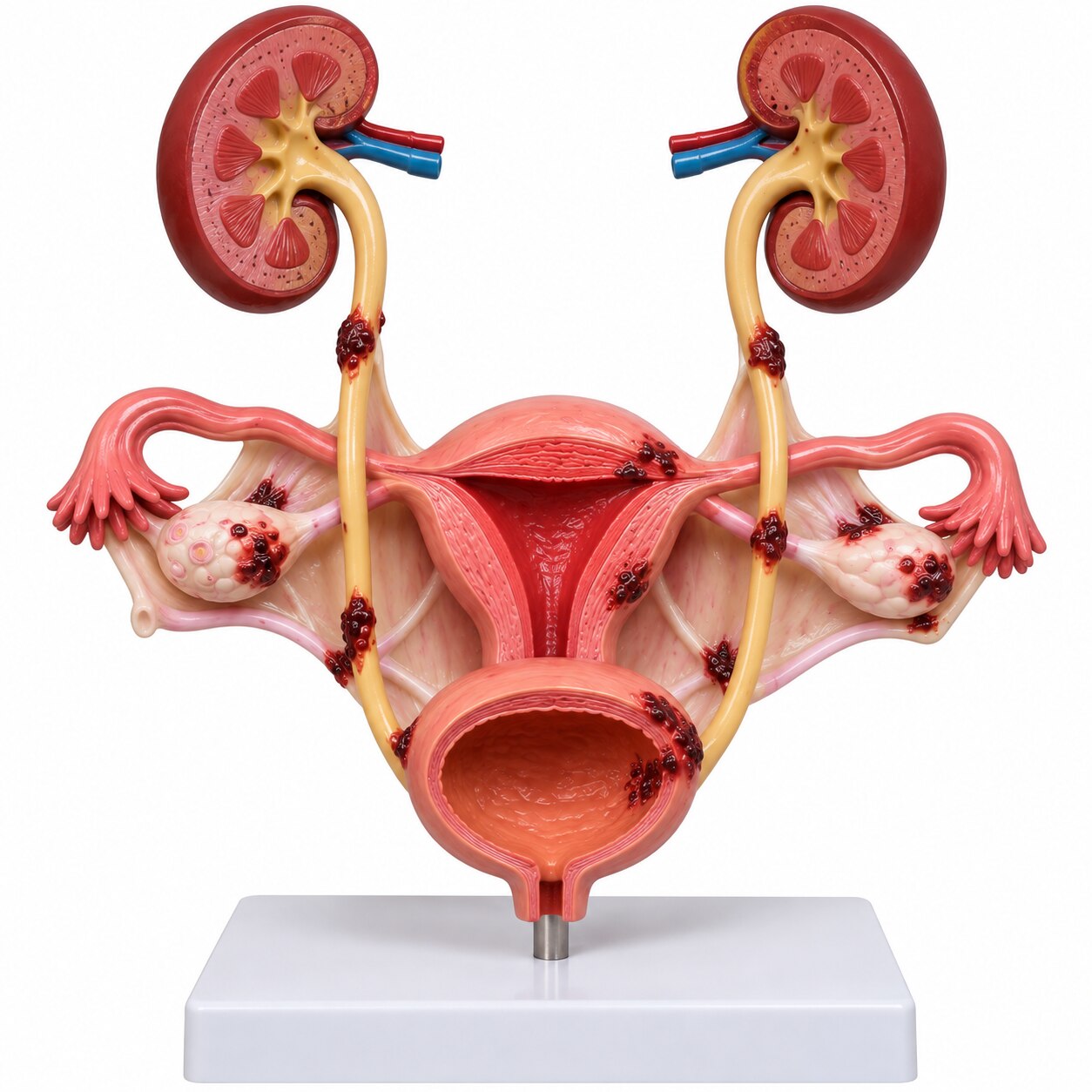
Ureteral endometriosis can threaten kidney function without causing strong urinary symptoms. Tissue around a ureter can narrow the tube carrying urine from the kidney to the bladder, creating hydronephrosis and gradual damage. Flank pain, recurrent urinary infections, blood in the urine, or no symptoms at all can occur.
Bladder disease | Ureteral disease Symptoms | Painful urination, urgency, frequency, bladder pressure, or blood in the urine | Flank or back pain, infections, blood in the urine, or no urinary symptoms Main risk | Irritation and reduced bladder comfort | Blocked urine drainage, hydronephrosis, and loss of kidney function What symptoms show | Symptoms often draw attention to the bladder | Symptoms can remain mild while obstruction progresses
Investigation starts with the timing of symptoms, a urine test, and urine culture. Blood tests such as creatinine and estimated glomerular filtration rate help assess kidney function, but normal results do not exclude early obstruction.
An expert transvaginal ultrasound can assess deep endometriosis and look for changes around the bladder and ureters. MRI maps the location and extent of deep disease, especially when surgery is being considered. A routine pelvic ultrasound reported as normal may not have examined these areas in sufficient detail.
Doctors may add imaging that checks urine drainage and cystoscopy when bladder disease or another urinary cause needs clarification. They also assess infection, stones, overactive bladder, bladder pain syndrome, pelvic-floor dysfunction, and other gynecological conditions. Hydronephrosis or suspected impaired drainage needs prompt urological and endometriosis-specialist review; hormonal treatment does not reliably remove established obstruction.
How should you prepare for an assessment?
Record symptoms for at least one menstrual cycle, including the date of each period, urinary frequency, urgency, burning, difficulty emptying, pelvic or flank pain, and any visible blood. Note whether symptoms begin before bleeding, peak during menstruation, or continue throughout the cycle.
1. Bring a symptom diary, medication list, previous urine-test reports, urine culture results, antibiotic names and dates, imaging reports, and operative or gynecological records. Photograph visible blood if you cannot tell whether it came from urine or vaginal bleeding.
2. Ask whether you need urinalysis and a urine culture before starting another antibiotic. A negative culture makes ordinary bacterial cystitis less likely, but it does not prove endometriosis; stones, bladder pain syndrome, overactive bladder, and pelvic-floor dysfunction can produce similar symptoms.
3. Ask whether an expert transvaginal ultrasound is appropriate for assessing the bladder, ureters, and deep endometriosis. A routine pelvic ultrasound reported as normal may not have been designed to detect disease in these locations.
4. Ask how the clinician will check for ureter narrowing, hydronephrosis, or kidney-function problems, particularly if you have flank pain or few urinary symptoms. Ask whether MRI is needed to map disease before treatment or surgery.
An Endometriosis Surgeon in Pune can help coordinate targeted imaging and urology input when the urinary findings and cycle pattern do not fit a simple infection. Share every result, including normal ones, because the pattern across tests often matters more than one report.
Related service
Urinary tract Endometriosis (UTE) occurs when endometrial-like tissue grows on or within the organs of the urinary tract. View service → |
Frequently asked questions
Which bladder symptoms can point to endometriosis?
Bladder endometriosis can cause painful urination, urgency, frequent urination, pressure above the pubic bone, incomplete emptying, and pelvic pain that worsens as the bladder fills. Symptoms that flare before or during menstruation deserve particular attention.
How can you tell bladder endometriosis from a UTI or bladder disorder?
A UTI often causes burning, urgency, and frequency with abnormal urine testing, while endometriosis symptoms can recur around menstruation and persist despite negative cultures or antibiotics. A clinician may need pelvic imaging, cystoscopy, or other tests to identify bladder involvement.
When do urinary symptoms need prompt or emergency care?
Seek prompt medical care for repeated urinary symptoms, blood in the urine, fever, worsening pelvic pain, or symptoms that do not improve after treatment. Go to emergency care for inability to urinate, severe flank pain, vomiting, fever with chills, or sudden severe pain.
Why can ureteral endometriosis be more serious than its symptoms suggest?
Endometriosis around a ureter can narrow the passage carrying urine from a kidney to the bladder. Blockage can progress with few urinary symptoms and damage kidney function, so persistent pelvic symptoms or unexplained flank pain need evaluation.
How should you prepare for an assessment?
Record symptom dates, menstrual timing, urine test results, antibiotics, visible blood, pain location, and changes in urine flow. Bring previous scans and operative reports, and ask whether evaluation should include the bladder, ureters, kidneys, and kidney function.