
Bloating, constipation, diarrhoea, cramping, nausea, and pain during bowel movements often look like ordinary digestive trouble. The pattern across your menstrual cycles, accompanying pelvic symptoms, warning signs, and the limits of routine bowel tests can help you decide what information to take to a clinician.
Key takeaways
- Track bowel symptoms against your menstrual cycle.
- Painful bowel movements during periods warrant medical assessment.
- Bowel endometriosis can affect the bowel surface, muscle, or deeper layers.
- Normal routine tests do not always exclude bowel endometriosis.
Which digestive symptoms can bowel endometriosis cause?
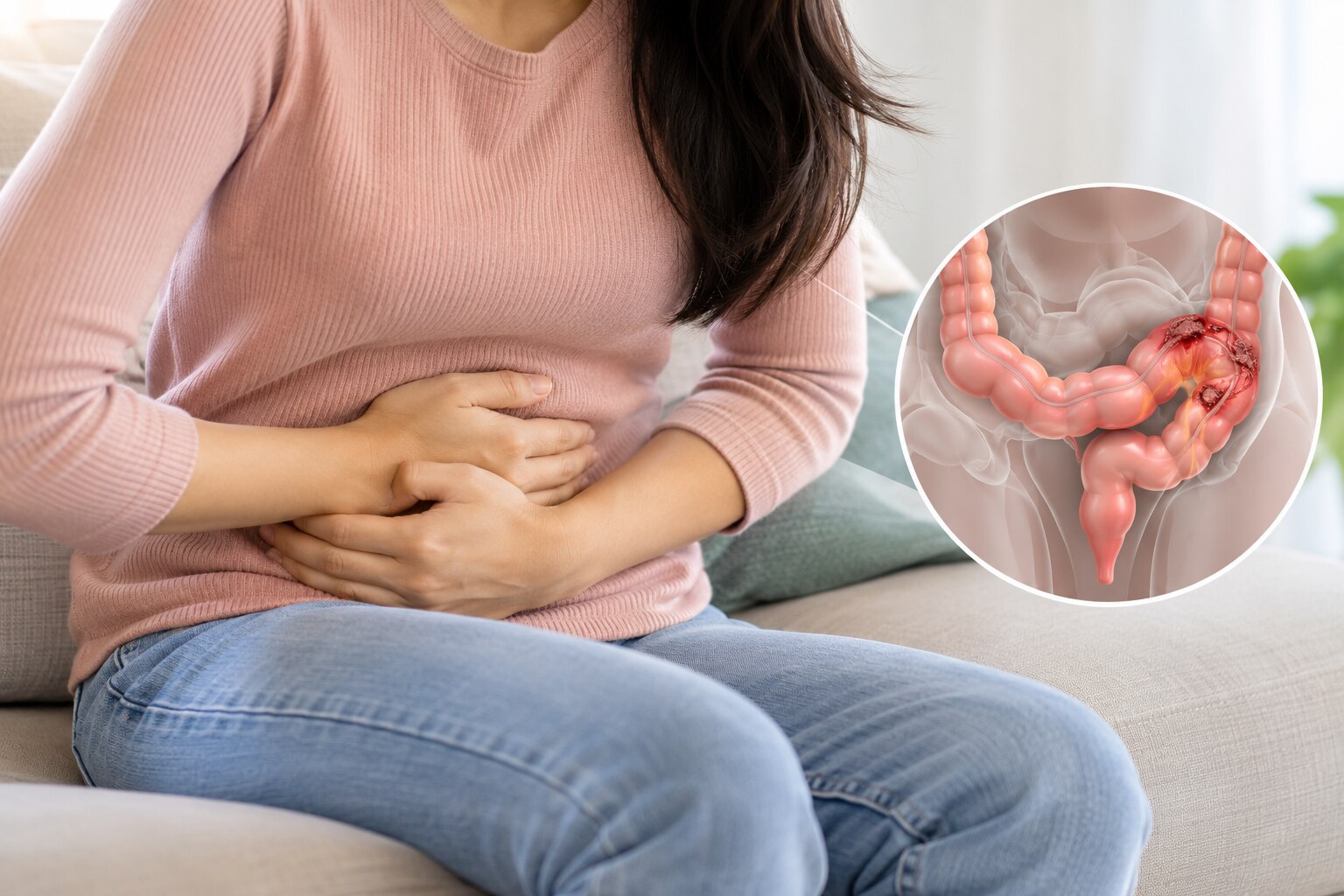
Bowel endometriosis can cause bloating, constipation, diarrhoea, intestinal cramping, nausea, painful bowel movements, rectal pain, tenesmus, and a feeling of incomplete evacuation. These bowel endometriosis symptoms can resemble IBS, food intolerance, or an ordinary change in bowel habit because no single symptom identifies the cause.
| Symptom | How it may feel |
|---|---|
| Bloating | Abdominal fullness, pressure, or visible swelling |
| Constipation or diarrhoea | Hard stools, loose stools, or alternating bowel habits |
| Cramping | Gripping abdominal or pelvic pain before passing stool |
| Painful bowel movements | Sharp or deep pain during defecation |
| Rectal pain | Aching or pressure near the anus, sometimes with an urgent need to open your bowels |
Timing provides an important clue. Record whether symptoms begin before menstruation, worsen during bleeding, improve after the period, or recur across several cycles. Endometriosis remains possible when symptoms continue throughout the cycle, especially after fibrosis has created a fixed narrowing.
Bowel symptoms can coexist with IBS, so improvement after IBS treatment does not exclude endometriosis. Seek prompt assessment for new persistent vomiting, severe worsening pain, marked abdominal distension, or inability to pass stool or gas; these signs can indicate obstruction rather than routine digestive upset.
What clues separate bowel endometriosis from other digestive conditions?
A useful separator is repetition across the menstrual cycle. Cyclical bowel symptoms that worsen before or during menstruation, ease afterward, and recur over several cycles raise concern for endometriosis more than pain with bowel movements alone, which also occurs with constipation, fissures, inflammatory bowel disease, or pelvic-floor dysfunction.
| Condition | Pattern that points toward it | Difference from cyclical symptoms |
|---|---|---|
| Irritable bowel syndrome | Recurrent pain with diarrhoea, constipation, bloating, or alternating stools | Symptoms fluctuate without a consistent menstrual pattern; IBS and endometriosis can coexist |
| Food intolerance | Bloating, cramps, or diarrhoea after a particular food and improvement when it is avoided | The trigger is dietary rather than reliably linked to menstruation |
| Inflammatory bowel disease | Persistent diarrhoea, urgency, weight loss, fatigue, fever, or blood in stool | Symptoms do not wait for a period and require medical testing |
| Constipation | Hard stools, straining, infrequent bowel movements, or incomplete evacuation | Symptoms improve after passing stool or treating constipation |
| Haemorrhoids | Bright-red blood, itching, a lump, or anal discomfort | Menstrual timing is not typical; rectal bleeding still needs assessment |
| Infectious gastroenteritis | Sudden diarrhoea, vomiting, cramps, fever, or sick contacts | It usually develops over hours and settles over days, not across repeated cycles |
No single symptom proves the cause. Visible rectal blood is not typical for most bowel endometriosis and should not be attributed to it automatically. Seek urgent assessment for persistent vomiting, marked abdominal swelling, inability to pass stool or gas, or rapidly worsening pain.
How do bowel location and disease depth change the symptoms?
Depth changes what the bowel can do. Lesions on the outer surface may irritate the bowel or create adhesions without blocking passage, so bloating or pelvic pain can occur while the inner lining looks normal. Deeper disease extends into the muscular wall and can alter movement or narrow the bowel.
| Location | How symptoms may differ | Other clues |
|---|---|---|
| Outer bowel surface | Pelvic aching, bloating, cramping, or pain from adhesions; bowel habits may remain normal | Pain often accompanies period-related pelvic pain or painful sex |
| Muscular wall of the rectosigmoid colon | Painful bowel movements, rectal pain, constipation, diarrhoea, incomplete evacuation, or alternating bowel habits | Symptoms can worsen before or during menstruation; deeper narrowing can make passing stool difficult |
| Other deep pelvic sites | Symptoms depend on the organ involved rather than bowel depth alone | Bladder or ureter involvement can cause urinary urgency, painful urination, or blood in urine during menstruation |
The rectosigmoid colon is the commonest bowel location, but lesions can affect the appendix, ileum, caecum, or other bowel segments. Deep endometriosis in the pelvis can link bowel symptoms with heavy periods, persistent pelvic pain, painful sex, and infertility; urinary symptoms point toward nearby urinary-tract disease, not necessarily bowel involvement.
None of these combinations proves the diagnosis, but they help a clinician decide what pelvic imaging should map.
Which symptoms need prompt assessment, and what should you record?
Arrange a routine appointment for bowel symptoms that persist, recur across several cycles, or interfere with work, sleep, eating, or bowel movements. A predictable flare before or during menstruation supports investigation, but bowel endometriosis can cause symptoms throughout the cycle when fibrosis or a fixed narrowing develops.
| Symptom or finding | Action | Why it matters |
|---|---|---|
| Bloating, constipation, diarrhoea, cramps, or painful defecation | Book a clinical assessment | These symptoms overlap with IBS and other digestive conditions |
| Blood in stool | Arrange prompt medical assessment | Rectal bleeding needs evaluation for gastrointestinal causes, even if it appears during menstruation |
| Persistent vomiting, marked abdominal distension, or severe escalating pain | Seek urgent medical care | These can signal bowel obstruction |
| Inability to pass stool or gas | Seek urgent medical care | A narrowing may be blocking the bowel |
Before your appointment, record:
- Menstrual cycle dates, including the first day of each period and when bowel symptoms begin or ease
- Stool frequency, consistency, urgency, incomplete evacuation, and any mucus or blood
- Pain location, severity from 0 to 10, relation to bowel movements, and whether it wakes you
- Vomiting, fever, weight change, abdominal swelling, painful sex, heavy bleeding, or urinary symptoms
- Medicines, laxatives, dietary changes, previous scans, and what improved or worsened symptoms
Keep the record for at least two or three cycles if you are well enough to wait for a routine visit.
Why can bowel endometriosis be missed on routine tests?
A normal colonoscopy does not exclude bowel endometriosis. Colonoscopy examines the inner mucosal lining and looks for intraluminal masses, while endometriosis often sits on the bowel’s outer surface or within its muscular wall, beyond the camera’s view.
| Test | What it shows | Key limitation |
|---|---|---|
| Colonoscopy | Mucosal disease, bleeding, polyps, or an intraluminal mass | A normal result can miss disease outside or within the bowel wall |
| Transvaginal ultrasound | Deep lesions, bowel-wall involvement, and rectosigmoid disease | Accuracy depends on the operator’s experience in deep endometriosis imaging |
| Pelvic MRI | Disease location, depth, bowel-wall involvement, and distance from the anus | A negative scan cannot rule out small lesions or superficial peritoneal disease |
| Laparoscopy | Direct inspection of the pelvis, with the option to biopsy or treat visible disease | It is invasive and may not show the full depth of bowel-wall involvement without careful assessment |
Transvaginal ultrasound and pelvic MRI are used to map disease and plan treatment, not merely to prove that symptoms are real. Persistent cyclical pain, painful bowel movements, or alternating bowel habits deserve specialist review when routine digestive tests are unrevealing.
An Endometriosis Surgeon in Pune can interpret the symptom pattern alongside examination and imaging rather than treating one negative result as conclusive. Seek prompt assessment for persistent vomiting, marked abdominal distension, inability to pass stool or gas, or severe escalating pain.
Related service
Bowel Endometriosis Endometriosis and Irritable Bowel Syndrome: Understanding the Double Struggle. View service → |
Frequently asked questions
Which digestive symptoms can bowel endometriosis cause?
It can cause bloating, constipation, diarrhoea, cramping, nausea, painful bowel movements, rectal pain, tenesmus, and incomplete evacuation.
What clues separate bowel endometriosis from other digestive conditions?
Symptoms that repeatedly worsen before or during menstruation, especially painful bowel movements or rectal pain, raise suspicion for bowel endometriosis.
How do bowel location and disease depth change the symptoms?
Disease on different bowel sections causes different patterns, while deeper lesions affecting the bowel muscle are more likely to cause pain, narrowing, constipation, or obstructed passage.
Which symptoms need prompt assessment, and what should you record?
Seek prompt assessment for severe or worsening pain, vomiting, a swollen abdomen, inability to pass stool or gas, heavy rectal bleeding, or faintness. Record symptom timing, bowel changes, bleeding, pain severity, and menstrual dates.
Why can bowel endometriosis be missed on routine tests?
Routine blood tests and standard digestive investigations may not show small or deep pelvic lesions. Diagnosis often requires a focused history, pelvic examination, specialist imaging, or laparoscopy.